
Quick answer
Here's what many cyclists don't realize: the Achilles tendon—the thick cord connecting your calf muscles to your heel—bears tremendous stress during cycling.
Looking for care? See Achilles & tendon pain treatment in Lake Mary & Orlando.
Doctors who treat Achilles & tendon pain


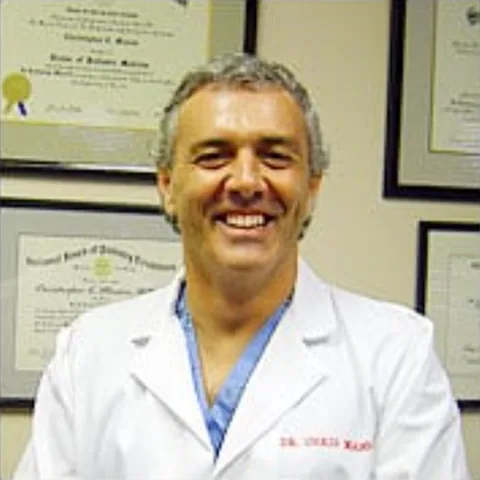

For endurance athletes and serious recreational cyclists, Achilles tendinitis represents one of the most underrecognized injuries, often dismissed as mere soreness until it becomes severe. Dr. Christopher Mason, FACFAS, has spent 30+ years treating overuse injuries in active populations, and he frequently encounters cyclists whose Achilles issues went unmanaged until pain forced them off the bike entirely.
Why Cyclists Are Uniquely Vulnerable
Cycling places sustained, repetitive load on the Achilles tendon in ways that running does not. The AAOS Achilles tendinitis page calls this an overuse problem, not a one-time twist: too much load too soon irritates the tendon that ties your calf to the heel. Unlike running, where your Achilles eccentrically loads (lengthens under tension) with each ground strike, cycling maintains fairly constant plantarflexion—your calf stays contracted in a shortened position for the entire ride. Over hours and hours of pedaling, especially at high cadences, this chronic tension accumulates.
Several factors amplify Achilles stress in cyclists:
Bike setup issues — Saddle height, position, and cleat placement directly influence calf and Achilles loading. A saddle too high forces increased plantarflexion; cleats positioned too far forward shift more work to the calf. Dr. Christopher Mason has seen numerous cyclists resolve Achilles problems simply by optimizing bike geometry with a professional fitter.
Intensity spikes — Sudden increases in volume (weekly mileage), intensity (hill repeats, sprinting), or both stress the tendon beyond its conditioning level. Even experienced cyclists can provoke Achilles tendinitis by ramping training too aggressively.
Calf tightness — Cyclists often develop chronically tight calf muscles. Restricted ankle dorsiflexion (upward ankle mobility) forces the Achilles to work harder with every pedal stroke, predisposing it to injury.
Age and recovery — As cyclists age, tendon recovery slows. A 50-year-old cyclist's Achilles recovers more slowly than a 30-year-old's from identical training stress.
Recognizing Achilles Tendinitis
Achilles tendinitis doesn't always announce itself dramatically. Many cyclists experience:
- Stiffness or soreness at the back of the heel, especially first thing in the morning or after a day off the bike
- Pain that worsens during rides, particularly on hills or at high intensities
- Swelling or thickening along the tendon itself
- A creaky or gritty sensation with ankle movement
- Discomfort that improves somewhat as the tendon "warms up" during a ride, then flares afterward
Dr. Christopher Mason emphasizes that "feel-good" pain relief during rides doesn't mean the injury is improving. Many cyclists push through Achilles discomfort, thinking it will resolve on its own. In fact, continuing to stress an inflamed tendon often progresses it into a chronic condition requiring months of recovery rather than weeks.
The Inflammation Timeline
Achilles tendinitis exists on a spectrum. Early-stage tendinitis (inflammation of the tendon sheath) responds quickly to conservative care—sometimes 2–4 weeks. However, if inflammation continues unchecked, it can progress to tendinosis (actual microscopic degeneration within the tendon), which requires 2–3 months of rehabilitation.
The worst-case scenario? Chronic, degenerated tendinosis combined with partial tears, which can sideline cyclists for 4–6 months and increase rupture risk if not managed carefully.
Dr. Christopher Mason's approach is to intervene early, before the injury progresses to these more serious stages.
Conservative Treatment Strategy
Relative rest — This is crucial and often misunderstood. Relative rest means reducing cycling volume and intensity, not eliminating activity entirely. Dr. Christopher Mason typically recommends:
- Avoid high-intensity intervals and hill repeats
- Continue easy, moderate-cadence cycling (lower load on the calf)
- Cross-train with swimming, pool running, or upper-body strength work to maintain fitness
Calf and Achilles stretching — Dedicated, consistent stretching addresses the root biomechanical issue. Calf stretches (standing wall stretch, downward dog) should be held 30–60 seconds and performed 3–5 times daily. Morning stretching before getting out of bed is particularly important.
Eccentric strengthening — Once acute pain subsides, eccentric loading (controlled lengthening under tension) strengthens the Achilles and promotes healing. Single-leg heel raises, where you lower slowly from the toes, directly target this mechanism.
Ice and anti-inflammatories — Ice after cycling for 15 minutes to manage swelling. NSAIDs (ibuprofen, naproxen) can help control pain and inflammation, especially in the acute phase. Dr. Christopher Mason may recommend a brief course to break the inflammation cycle.
Bike fit optimization — Have a professional cycling fitter evaluate your position. Saddle height, cleat position, and crank arm length all influence Achilles loading. Even small adjustments often provide significant relief.
Heel lifts or custom orthotics — Temporary heel lifts (even 5–10mm) reduce Achilles stretch during cycling. Custom orthotics can optimize foot biomechanics and reduce calf workload.
Signs You Should Schedule a Visit (Imaging or Advanced Treatment)
Most Achilles tendinitis resolves with conservative care. However, if pain persists beyond 6 weeks or worsens despite proper management, Dr. Christopher Mason may recommend imaging (ultrasound or MRI) to assess tendon integrity.
Advanced conservative options include:
- Corticosteroid injections — Used judiciously and cautiously, these can reduce pain and inflammation but carry risks if overused
- Platelet-rich plasma (PRP) or other biologics — Emerging evidence suggests these may accelerate tendon healing, though more research continues
- Extracorporeal shock wave therapy (ESWT) — Some evidence supports this for chronic cases
Surgery is rarely necessary and typically reserved for athletes with complete tears or significant functional limitations despite aggressive conservative care.
Your Cycling Future
With proper early management, most cyclists return to full training within 4–12 weeks depending on severity and compliance with rehabilitation. Dr. Christopher Mason specializes in both conservative and surgical approaches, so you have expert guidance through your entire recovery journey.
The key is addressing Achilles tendinitis early, before it becomes a chronic limitation. Don't dismiss that morning stiffness or post-ride soreness—these are warning signs worth professional evaluation.
Sources
- Foot Health Facts (ACFAS): Achilles Tendon Disorders
- OrthoInfo (AAOS): Achilles Tendinitis
- American Podiatric Medical Association: Tendinitis
Medical advice disclaimer. This page is general education, not medical advice. It does not replace an exam, diagnosis or treatment from a licensed professional. For a foot or ankle concern, book a visit or call (407) 307-0006. In an emergency, call 911.